
| Indicator | Unit | 900/200 | 1200/300 | 2000/150 |
| Excavation width | mm | 200 | 300 | 150-200 |
| Excavation depth | mm | 900 | 1200 | 2000 |
| Work pressure | MPa | 16 | 16 | 16 |
| Workflow | L/mm | 50-75 | 50-125 | 50-125 |
| Length | mm | 1950 | 3300 | 3300 |
| Width | mm | 1160 | 1265 | 1265 |
| Height | mm | 850 | 900 | 900 |
| Weight | kg | 320 | 530 | 730 |
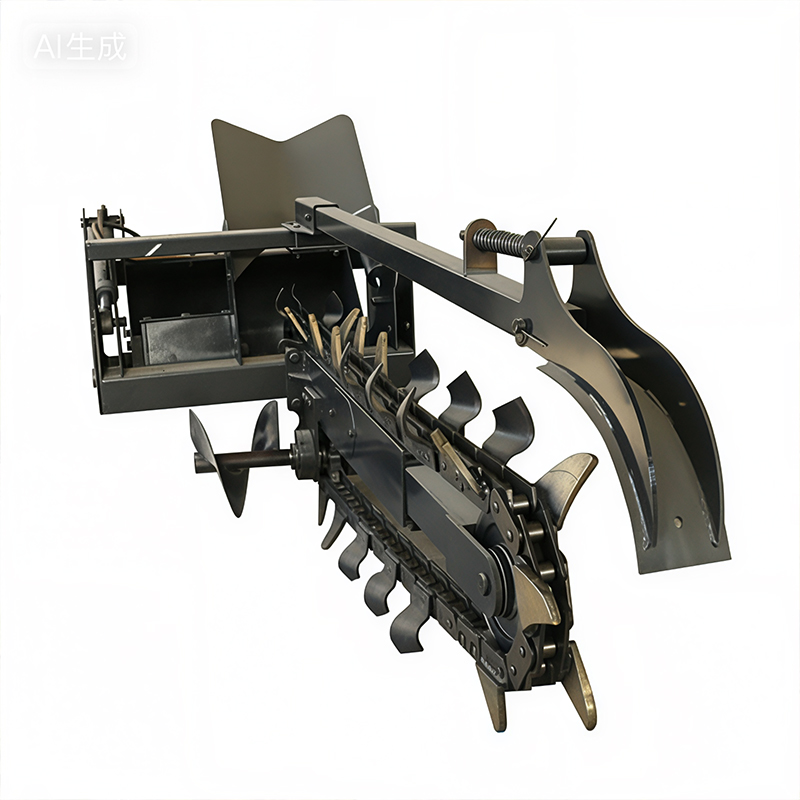
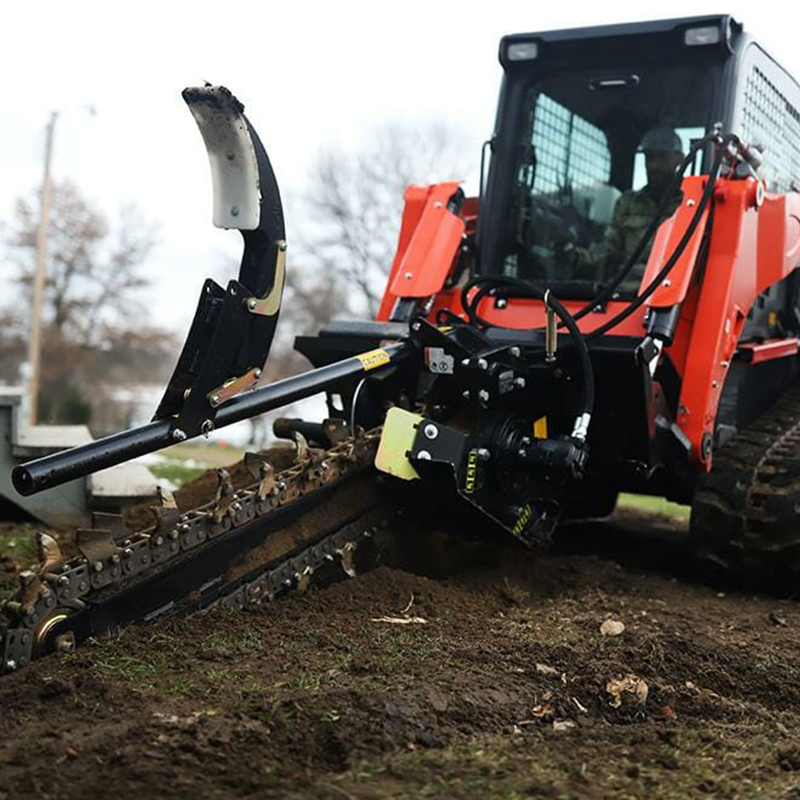
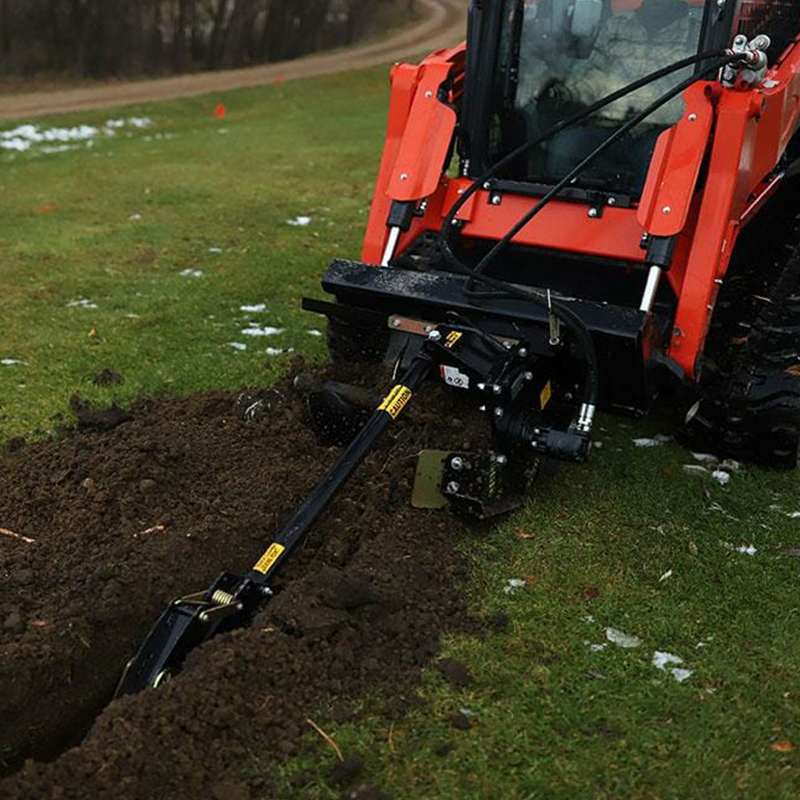
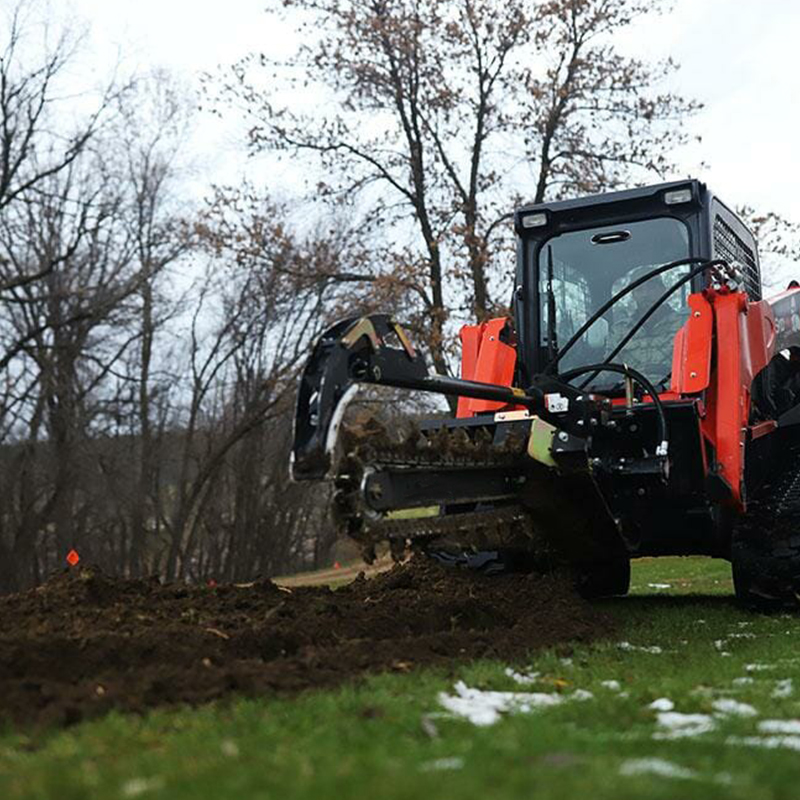
Chain type trenching machine: driven by the hydraulic driving force of the sliding loader, the hydraulic motor drives the chain with blades to rotate. The blade teeth cut the soil and bring it to the ground, and then the soil is transported to one or both sides of the trench by the screw conveyor, thus completing the trenching operation.
Disc type trencher: Also powered by a skid steer loader, it drives the disc type cutting tool to rotate. During the rotation process, the disc cutting tool cuts the soil, excavates it, and throws it onto the ground. As the equipment moves, it gradually forms a ditch.
Power system: It mainly relies on the hydraulic system of the skid steer loader to provide power, and some trenchers may also be equipped with independent engines to enhance power output and meet the trenching needs under different working conditions.
Cutting system: The cutting component of the chain trencher is a chain with blades, which are usually made of special materials and processes and have high wear resistance and cutting ability; The disc-shaped trencher uses disc-shaped cutting tools, and the shape and material of the tools are designed according to different working scenarios.
Conveyor system: generally composed of a screw conveyor or scraper, responsible for transporting the cut soil from the bottom of the ditch to one or both sides of the ditch for subsequent cleaning and treatment.
Control system: used to control various actions of the trenching machine, such as adjusting the trenching depth, width, speed, etc., usually connected to the control system of the skid loader, making operation convenient and fast.
Efficiency: It can quickly excavate ditches and trenches, which greatly improves work efficiency compared to manual or traditional excavator digging, and can save a lot of time and labor costs.
Accuracy: It can accurately control the depth and width of the trench, with neat trench walls, flat trench bottoms, uniform trench depth and width, meeting the strict requirements of various engineering projects for trench dimensions.
Flexibility: The skid steer loader itself has the characteristics of small size, flexibility, and small turning radius. When paired with a trencher, it can operate in narrow spaces, complex terrains, and other environments, such as urban streets, farmland paths, orchards, etc., and can easily cope with them.
Multifunctionality: In addition to the trenching function, some trenching machines can also achieve various functions such as loosening soil, fertilizing, and burying pipelines by replacing different cutting tools or accessories, further expanding their application scope.
Durability: The key components of the trenching machine, such as chains, blades, hydraulic motors, etc., are usually made of high-quality materials and advanced manufacturing processes, with high strength and wear resistance, able to adapt to long-term, high-intensity work, reduce the probability of failure, and lower maintenance costs.
In the field of agriculture, it is widely used in agricultural water conservancy construction, such as excavating irrigation channels, drainage pipelines, as well as trenching, fertilization, and ridge formation in orchards and vegetable gardens, which helps to improve agricultural production efficiency and promote crop growth.
Municipal engineering: It can be used for the burial of underground cables, communication optical cables, water supply and drainage pipelines, gas pipelines, etc. in urban roads, squares, parks and other places, as well as the excavation of rainwater collection ditches and sewage discharge ditches, providing strong support for urban infrastructure construction.
Landscape: In landscape engineering, it is used to excavate basic ditches for landscape streams and ponds, as well as lay irrigation pipes, cables, etc., to help create a beautiful and comfortable garden environment.
Construction engineering: In construction, it can be used to excavate foundation trenches for buildings, drainage trenches for basements, etc., laying the foundation for the smooth progress of construction projects.